Best AI co-founder: how to actually choose one
Quick answer: There is no single best AI co-founder, and any ranking that pretends otherwise is guessing about your idea, your stage and your honesty. What matters is behaviour. The best AI co-founder for you disagrees with you on purpose, pushes you towards real customer evidence, tracks what you have actually proven rather than what you hope, and is upfront that it cannot hold equity or be accountable for you. Judge every option, free or paid, against those four things. The right one will sometimes ruin your afternoon and save you a year.
More people are building companies alone than at almost any point before.
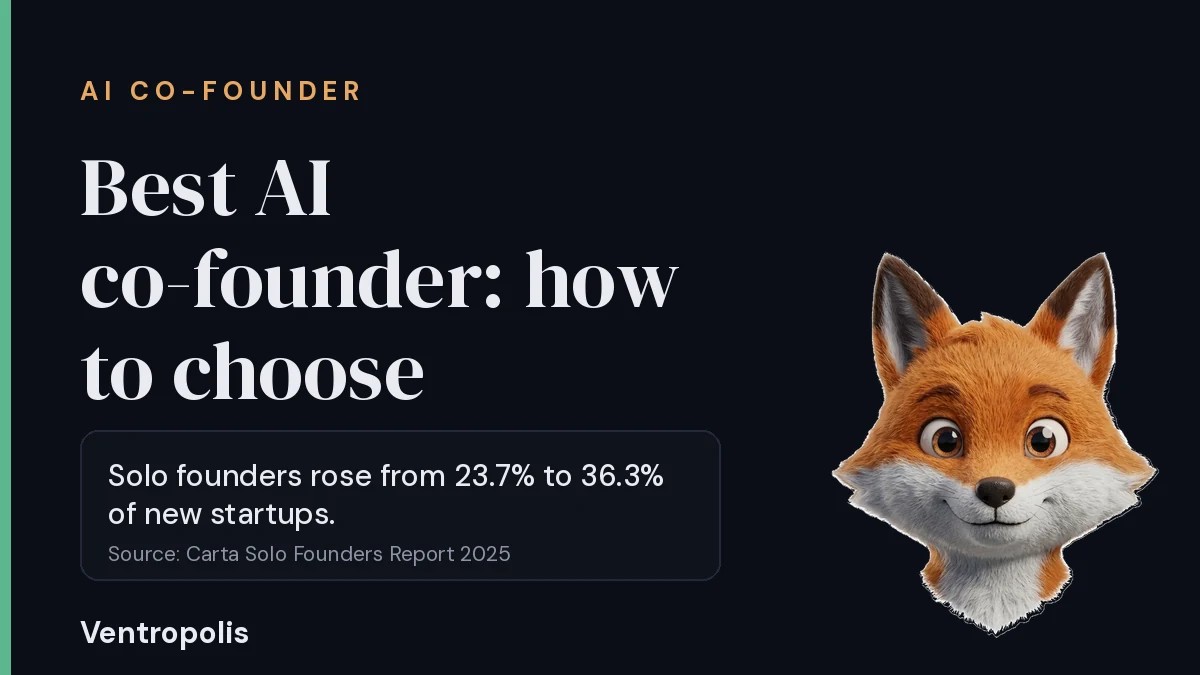
Carta's Solo Founders Report 2025 puts numbers on it: the share of new startups with a single founder rose from 23.7% in 2019 to 36.3% in the first half of 2025. Their read is that AI is part of the reason, a force multiplier that lets one person build and sell what used to need a team.
That is also why "best AI co-founder" is suddenly a search worth a lot of money. More solo builders, more people wanting the one thing a co-founder gave that software might too.
So let me talk you out of trusting the ranking, and give you the way I would actually choose.
Why "best" is the wrong question
A list of the best AI co-founders cannot know what you are building. It cannot see which assumption in your plan is the one that quietly kills you if it is wrong.
"Best" is not a property of the tool. It is a match between the tool and the gap you actually have.
And the same Carta data hints at the trap. Solo-led companies were 30% of startups founded in 2024 but took only 14.7% of the cash raised in priced rounds that year. Building alone is easier than ever; getting the market and the money to agree is not. A co-founder, human or AI, earns its keep by closing that gap, not by making the building feel less lonely.
The one job to judge it on
An AI co-founder is worth having for one reason: it is the honest partner you lose the moment an idea becomes yours. So judge it on that job, and nothing else.
Four behaviours, in order of importance.
It disagrees on purpose. If it mostly agrees, walk away. A partner tuned to please you is worse than none, because it launders your bias back to you as confidence.
It sends you to customers. The best tool does not settle your question. It turns your idea into testable assumptions and writes customer questions that do not secretly pitch, so the evidence comes from outside your own head.
It keeps score honestly. It tracks what you have proven versus what you still assume, so a polite "sounds great" never gets promoted to demand by accident.
It is honest about its limits. A good one will tell you plainly that it cannot be the customer and cannot be accountable for you. If it implies otherwise, it is selling comfort.
That is the whole rubric. Everything else is decoration.
I have taken one company all the way to a sale, and the luck-to-skill ratio in that outcome was higher than I would like to admit. The lesson that stuck was not about working harder. It was that the people worth keeping close were the ones willing to disagree with me before the disagreement got expensive. That is the exact quality I now look for in a tool.
What no AI co-founder can be
Do not pay for a promise no software can keep.
None of them can generate demand. None can sign your first customer, share your legal risk, or make you do the hard test at 6am when nobody is watching. If a product hints that it validates your idea without you talking to a single person, that is the tell. The evidence has to be real, and it has to come from people who are not you.
If you want the wider version of this rubric across every kind of validation tool, I wrote it up in best startup validation tools 2026. And if you are still deciding whether an app can do the job at all, the AI co-founder app test walks through the six questions I would ask before installing one.
For what it is worth, this is the tool I wanted to exist, so we are building it. Foxy is an AI co-founder designed against the flattery trap: it disagrees on purpose, ranks your assumptions, writes customer questions that do not lead the witness, and tracks your evidence instead of your enthusiasm. It is the objective partner you lose on your own idea, not a button that prints a verdict. If that is the gap you have, start here.
So before you pick the "best" one, answer the only question that decides it: do you want a co-founder who tells you the truth, or a product that tells you what you hoped to hear?