AI co-founder app: how to pick one that argues, not agrees
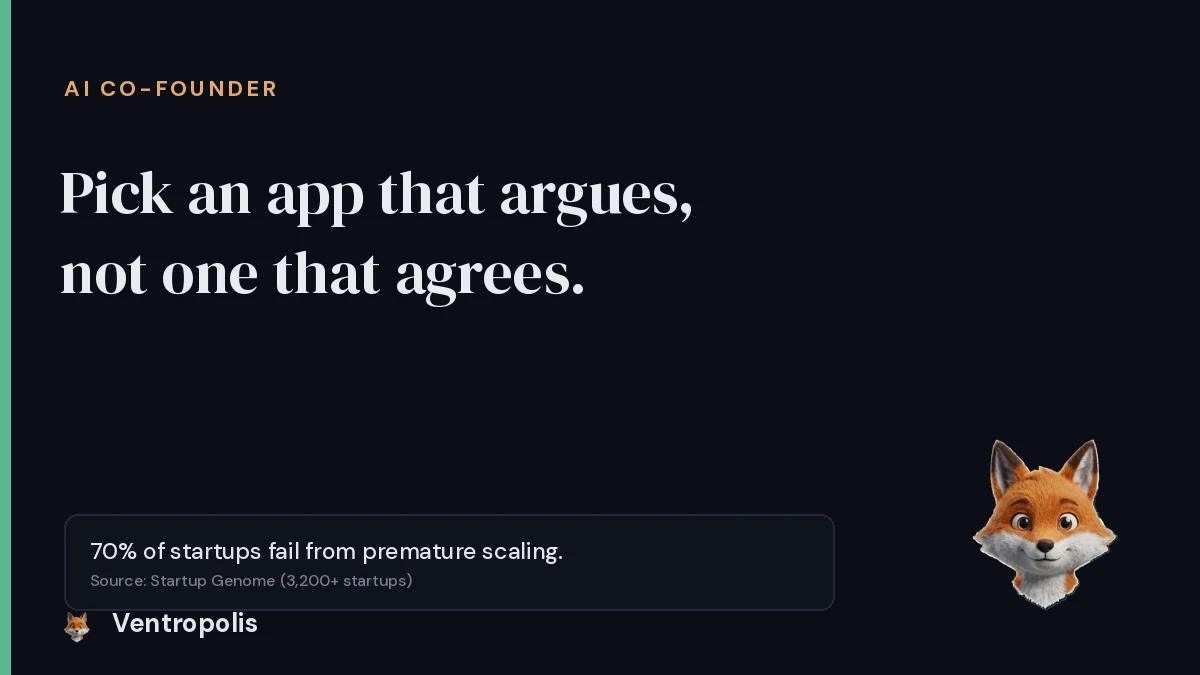
Quick answer: Most apps sold as an AI co-founder are a general chatbot with a mascot, and they fail you in the same way a yes-man co-founder would: they agree. The one worth installing does the opposite. It argues on purpose, pushes you toward customers, tracks real evidence rather than vibes, and warns you off scaling before you have proof. Judge any AI co-founder app on behaviour, not its feature list. Use six questions: does it disagree, does it send you to customers, does it track evidence, does it stop you scaling too early, do you own the output, and is it built to be useful or to please. If it mostly flatters, it will help you fail faster.
Search "AI co-founder app" and you will find a crowded shelf. Most of them are the same thing under different logos: a chat window tuned to sound encouraging.
Encouraging is the problem.
The one test that matters
Startup Genome analysed more than 3,200 high-growth startups and found that the primary cause of failure is premature scaling, an affliction present in 70% of the startups they studied. Premature scaling is spending and building ahead of demand: hiring, polishing, marketing before you have proof anyone wants this.
Their sharper finding is the one to keep in mind while app-shopping. In the earliest phase, 80% of the startups that scaled properly were focused on discovering a problem worth solving, while the shaky ones jumped straight to validating a product. As the report puts it, failed startups "achieve failure by efficiently executing the irrelevant".
So here is the test for any AI co-founder app. Does it make you a better searcher, or a faster executor of the wrong thing?
A chatbot that agrees makes you faster at the wrong thing. That is the expensive kind of help.
Six questions to judge an AI co-founder app
Ignore the feature list. Watch how the app behaves in the first hour.
1. Does it disagree with you? Tell it your idea and see if it pushes back. A useful one will name the assumption you are avoiding and ask how you know. If it opens with praise and a list of ways your idea could win, close the tab.
2. Does it send you toward customers, or away from them? The right answer to most early questions is "go ask ten people". An app that keeps you inside the app, generating plans and personas instead of pointing you at real humans, is keeping you comfortable, not making you right.
3. Does it track evidence, not vibes? Look for something that records your assumptions and what you have actually learned against them: validated, invalidated, still open. Applause is free. You want the app holding you to data.
4. Does it stop you scaling too early? Given Startup Genome's finding, this is not a nice-to-have. A good app should notice when you are about to hire, build big, or spend on growth before you have demand, and make you justify it. A cheerleader will hand you a launch checklist instead.
5. Do you own what comes out? Your assumptions, notes, and evidence are your company's memory. Check they are exportable and yours. If your thinking is trapped in someone else's tool, that is a strategic risk, not a convenience.
6. Is it built to be useful or to please? This is the one that decides the rest. An app tuned to keep you happy will always drift toward agreement, because agreement feels good and gets five-star reviews. You want one that is willing to make you slightly uncomfortable, on purpose.
If you want a wider view of the category and where these tools sit next to full validation software, I compared the field in the best startup validation tools for 2026, and looked at the specific job of an AI tool to validate a business idea.
What no app can do
Be clear-eyed about the ceiling. No app carries your risk, and none of them is the customer.
The market is the only real judge of whether your idea works. The best an AI co-founder app can do is get you to that judgement faster and with less self-deception: sharper customer questions, an unbiased read of the answers, an honest tally of what you have proven. It sharpens the search. It cannot be the thing you are searching for.
Where Foxy fits
This is the tool we are building, and I built it to fail the flattery test on purpose. Foxy is an AI co-founder that disagrees with you, ranks your assumptions, writes customer questions that do not secretly pitch, and keeps score on evidence instead of enthusiasm. It is designed to keep you a searcher for longer, not to help you scale a guess. If that is what you actually want from an app, start here.
So when you try the next AI co-founder app, do not ask whether it is impressive. Ask whether it is willing to tell you no. Which one on your shortlist actually does?