Can an AI tool validate your business idea? An honest answer
Quick answer: An AI tool can genuinely help you validate a business idea, but not in the way the marketing implies. It is very good at the parts founders are worst at: naming your riskiest assumption, drafting honest customer questions, spotting bias in your own notes, and turning a stack of interviews into a clear read of what is proven. It cannot do the one thing validation actually requires, which is generate real demand. That still comes from customers. Treat the tool as a faster, more objective co-pilot for the thinking, not a machine that hands you a verdict. The evidence has to be real, and it has to come from outside the software.
Type your idea into a chatbot and it will tell you it is promising.
Of course it will. It was built to be helpful, and a confident yes feels helpful. That is the whole problem.
The gap between using AI and getting value from it
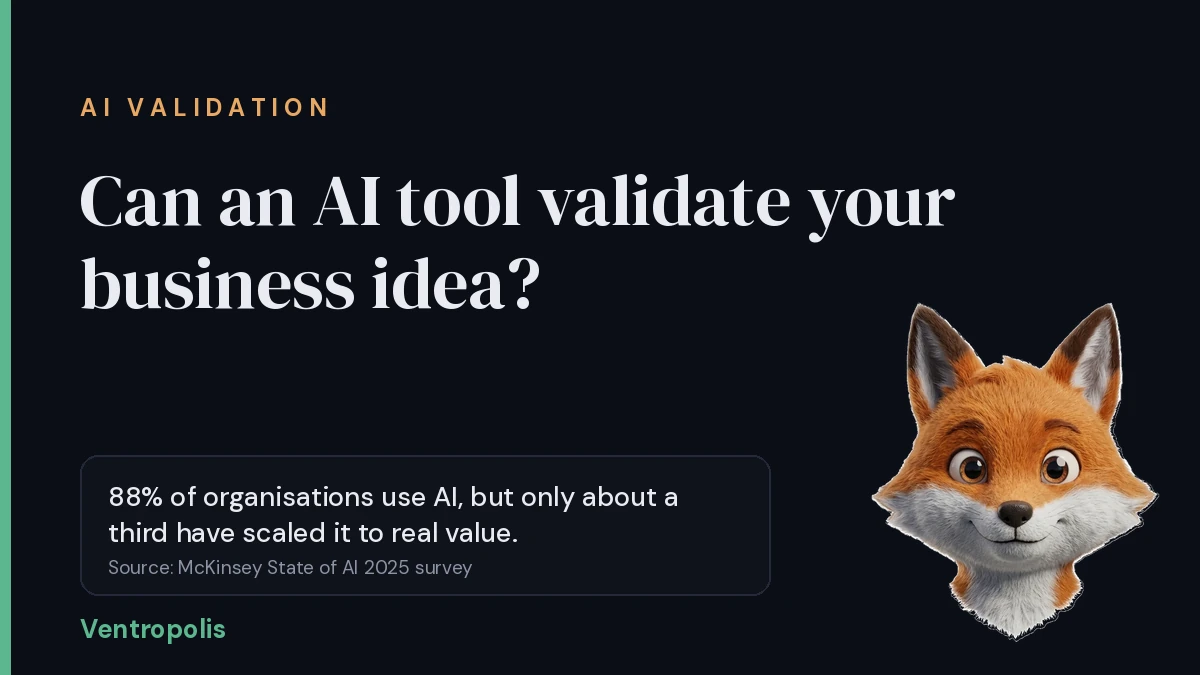
There is a useful pattern in how companies adopt AI that maps almost exactly onto founders validating ideas. In McKinsey's 2025 State of AI survey, 88 percent of organisations reported regularly using AI in at least one business function. Near-universal adoption. But most were still stuck in piloting, with only about a third having begun to scale it, and just 39 percent reporting any measurable profit impact at all.
Nearly everyone is using the tool. Far fewer are getting real value from it.
The report's own read on why is the interesting part: the value did not come from having AI. It came from redesigning how the work is done around it. The tool was necessary and nowhere near sufficient.
An AI tool for validating your idea is exactly the same. Owning it changes nothing. How you use it changes everything.
What an AI tool is genuinely good at
Here is where the software earns its place, and it is not a small list.
It is objective in the one spot you cannot be. You need your idea to be true, so you read your own customer notes generously and skip the parts that sting. An AI tool has no ego in your idea. Point it at your interview transcripts and it will flag the polite non-answers you counted as yeses.
It is fast at structure. It can take a vague idea and break it into the assumptions it depends on, then help you rank them by which one, if wrong, kills the whole thing. That is the core of validating before you build, and it is tedious to do by hand.
It writes better questions than you do under pressure. Good customer questions are hard because your instinct is to pitch. A tool with no emotional stake will draft the neutral, past-behaviour questions that actually get you truth.
And it is tireless at synthesis. Ten interviews is a lot to hold in your head. AI will summarise the pattern, separate the signal from the one loud outlier, and tell you what is still unproven.
What it flatly cannot do
Now the line, and it is a hard one.
An AI tool cannot want your product. It cannot feel the problem, cannot open its wallet, and cannot introduce you to ten people who have the pain. It has no access to real-world demand, so it cannot manufacture the one thing you are actually testing for.
If a tool gives you a "go" verdict with no customer evidence behind it, it did not validate anything. It generated a plausible opinion. That is a different thing wearing the same coat.
This is the trap in a lot of "AI idea validators". They return a confident score in thirty seconds, and the score is built from the model's general knowledge, not from anyone who would pay you. Confidence is cheap to generate. Evidence is not. The lean approach to validation is built on that exact distinction: learning from the real world, not from a convincing internal argument.
Use it to run the test, not to skip it
The right mental model is simple. The AI tool is the co-pilot for the thinking. The customers are the source of truth.
Use it to name the riskiest assumption. Use it to write the questions. Then go and have the real conversations, the ones only a human can have. Feed the answers back in and let the tool show you, without flattery, where the evidence is thin and which assumption you are still avoiding.
The founders who get value from AI are the ones who redesign their process around it, the same lesson the McKinsey data shows for companies. The ones who get nothing are the ones who typed their idea in, got a yes, and called it proof.
Where Foxy fits
This is the exact tool we are building. Foxy is an AI co-founder designed to do the opposite of cheerlead: it structures your assumptions, drafts your customer questions, reads your interviews for real signal, and tells you plainly where your idea is still a guess. Its job is to be the objective second opinion you lose on your own idea, not a button that prints a verdict. If you want your idea pressure-tested honestly before you spend the months, start here.
So the real question is not whether an AI tool can validate your idea. It is whether you will use it to face the evidence, or to avoid it. Which one are you actually looking for?