The best AI business coach: how to judge one, not rank them
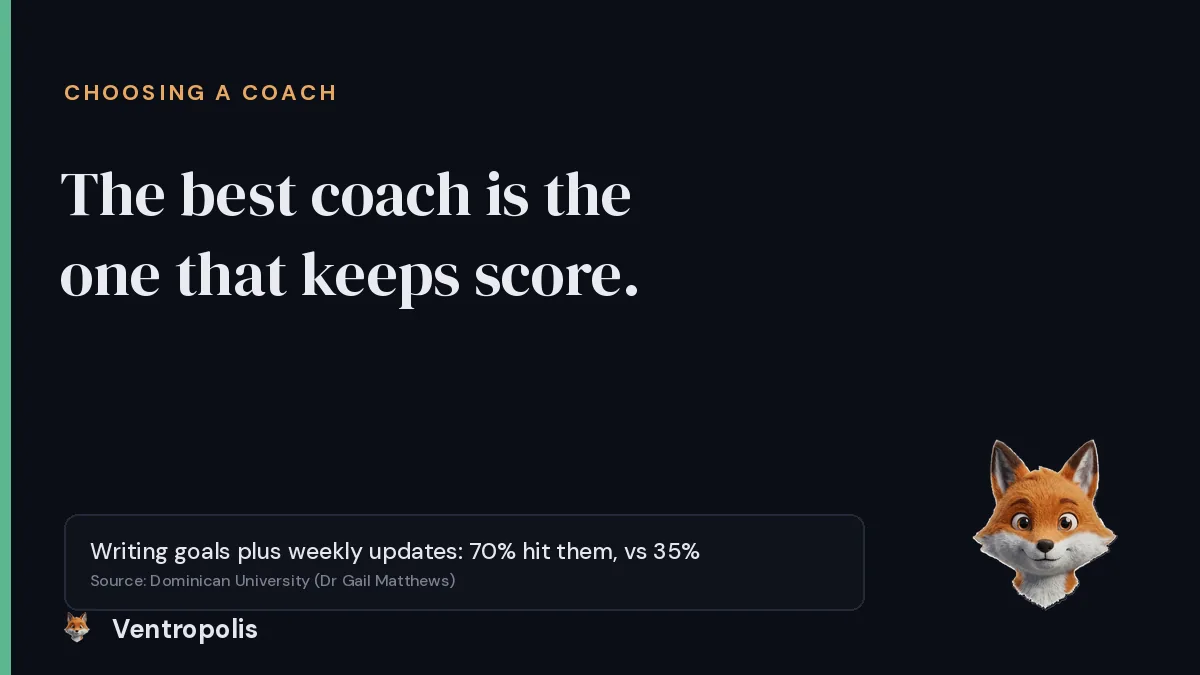
Quick answer: The best AI business coach is not the one with the smoothest demo or the longest feature list. It is the one that changes what you do: it makes you write your goals down, it checks in on them without being asked, and it keeps score honestly instead of flattering you. Research on goal achievement backs this: people who wrote their goals and reported progress weekly hit them far more often than people who just thought about them. So judge any AI coach on four behaviours, not on branding: does it force written commitments, does it follow up, does it disagree, and does it track your evidence over time. Pick on that, and the "best" answers itself.
Best is the wrong word. It hides the only question that matters.
When you type "best AI business coach" into a search bar, you are hoping someone will just tell you which one to buy. I understand the pull. It would be quicker.
But there is no ranking that survives contact with your actual situation, because a coach is only as good as the behaviour it changes in you. The right one for a solo founder with an untested idea is not the right one for a growth-stage team.
So let me give you something more useful than a list: a test you can run on any option, in about five minutes.
Why most "best of" rankings are useless here
Most best-of lists are ranking the wrong thing. They score the interface, the model, the price, the number of integrations. All easy to measure, all close to irrelevant.
A coach's value is not its features. It is whether you behave differently because it exists. A gorgeous app you ignore after week two coached you exactly nothing. A plain one that nags you into writing your goals down and reporting back changed your odds.
Rankings measure the app. You should be measuring the behaviour.
The one test that matters
Here is the test. Does the coach make you write your goals down, follow up on them, and keep score?
That sounds almost too simple. It is not. It is the part of coaching with the strongest evidence behind it.
In a study of 267 people across businesses and networking groups, Dominican University psychologist Dr Gail Matthews found that more than 70% of participants who wrote their goals down and sent weekly progress updates to a friend reported hitting them, compared with 35% who kept their goals to themselves without writing them down. Matthews summed it up as empirical evidence for three coaching tools: accountability, commitment, and written goals.
Read that again, because it is the whole buying decision. The mechanism that doubles goal achievement is not charisma or clever prompts. It is written commitment plus regular accountability. So the best AI business coach is simply the one that reliably makes you do those two things.
I have run one company all the way to an acquisition, and the outcome leaned on luck as much as judgement. The habit I kept afterwards was boring and unglamorous: write the goal, name the test, report the result, whether it flattered me or not. Any coach, human or AI, that enforces that habit is earning its keep. One that skips it is entertainment.
Four checks before you pick
Run each option through these. Fast pass or fail.
Does it force written commitments? If it lets you leave with a vague "I will talk to some customers," it is not coaching. It should make you write the specific goal and the deadline.
Does it follow up unprompted? A coach that only speaks when you open it is a search box. The value is the check-in you did not initiate, on the test you were quietly avoiding.
Does it disagree with you? If it agrees with every plan you bring, it was built to please, and a yes-man coach is worse than none because it feels like validation. You want the one that names the assumption you are dodging.
Does it keep score over time? If every session starts from a blank slate, there is no accountability, just fresh encouragement. It should remember what you promised last week and ask about it.
Four checks. A coach that passes all four will out-perform a slicker one that passes none. This is the same behaviour-first logic I used to judge the best AI co-founder, because the failure modes are identical.
What no AI coach can be
One honest limit, so you buy with your eyes open.
An AI coach's accountability has an off switch, and the switch is you. It cannot make you report back. It will not know you skipped the customer calls unless you admit it. That is real, and it is why the design matters: the best ones make ignoring them feel like a decision, not a default.
For the highest-stakes moments, a person who will be disappointed in you is still stronger than any prompt. Use the AI coach as the everyday scorekeeper, and keep the discipline of testing before you commit, the same loop I describe in how to validate a startup idea before building.
Where Foxy fits
This is the tool we are building, so I will be direct about what it is for. Foxy is designed around that one test: it makes you commit your riskiest assumptions in writing, it disagrees with you on purpose, and it holds the evidence so you cannot quietly rewrite history. It is a scorekeeper for your idea, not a cheerleader. If that is what "best" means to you, start here.
So before you pick the best AI business coach, ask the question the rankings never do: which one will still be changing what you do in week six?