An AI business coach for founders: what it can and cannot coach
Quick answer: An AI business coach for founders is software that does the useful half of coaching: it challenges your idea, asks the questions you are avoiding, and holds you to a method instead of your mood. The half it cannot do is real accountability, the kind you cannot switch off when nobody is watching. So it is not motivation on tap. It is an objective coach for the one thing that actually decides whether your company lives: is the idea real, and are you testing it or just believing it? Used that way, an always-on AI coach beats a monthly pep talk you cannot afford weekly anyway.
Picture the room at a pitch day. A founder finishes, the coach nods, and says "back yourself, the market will catch up."
It feels great. It is also close to useless.
That is the trap with a lot of business coaching for founders. It coaches the mood. And the mood was never the problem.
Coaching is not the same as cheerleading
Most founders do not lack belief. If anything they have too much of it. What they lack is someone who will look at the idea they are in love with and calmly say, "I am not sure that is true."
A coach's real value is not the pep talk. It is the pressure. The good ones make you defend your assumptions out loud, then poke the weakest one until you admit you have no evidence for it. That is uncomfortable, which is exactly why it works.
If your coach only ever leaves you feeling better, you are paying for a feeling. A founder does not need to feel better about an idea. A founder needs to find out whether the idea is any good, fast, while changing course is still cheap.
Coach or co-founder? They are not the same job
People mix these up, so let me draw the line.
A co-founder shares ownership, carries load, and has their own money and years on the line next to yours. That is a stake, not a service.
A coach does none of that. A coach guides you, challenges you, and holds you to a process. No equity, no risk, just an outside brain and a method. If you want the fuller version of the ownership question, I wrote about an AI co-founder for founders separately.
This matters because it tells you what an AI can and cannot stand in for. An AI cannot be your co-founder; it carries none of your risk. But the coaching job, the challenge and the method, is exactly the kind of thing software can do well, and cheaply, and at 6am on a Sunday.
What an AI business coach should actually coach
Point it at the idea, not the founder.
A useful AI business coach for a founder does three unglamorous things. It makes you name your riskiest assumption instead of hiding it inside a plan. It writes customer questions that do not secretly pitch your solution. And it reads your interview notes without the optimism that turns "interesting" into "they will buy."
That is coaching the loop. Assumption, test, evidence, decision, repeat. The same discipline I describe in how to stop confirmation bias when validating, because confirmation bias is the exact thing a coach is supposed to catch and you cannot catch in yourself.
Notice what is missing from that list: motivation. Coaching your confidence is easy and mostly a waste this early. Coaching your evidence is hard and it is the whole game.
Why the "always on and cheap" part matters
Here is the practical case for an AI coach, and it is not romantic.
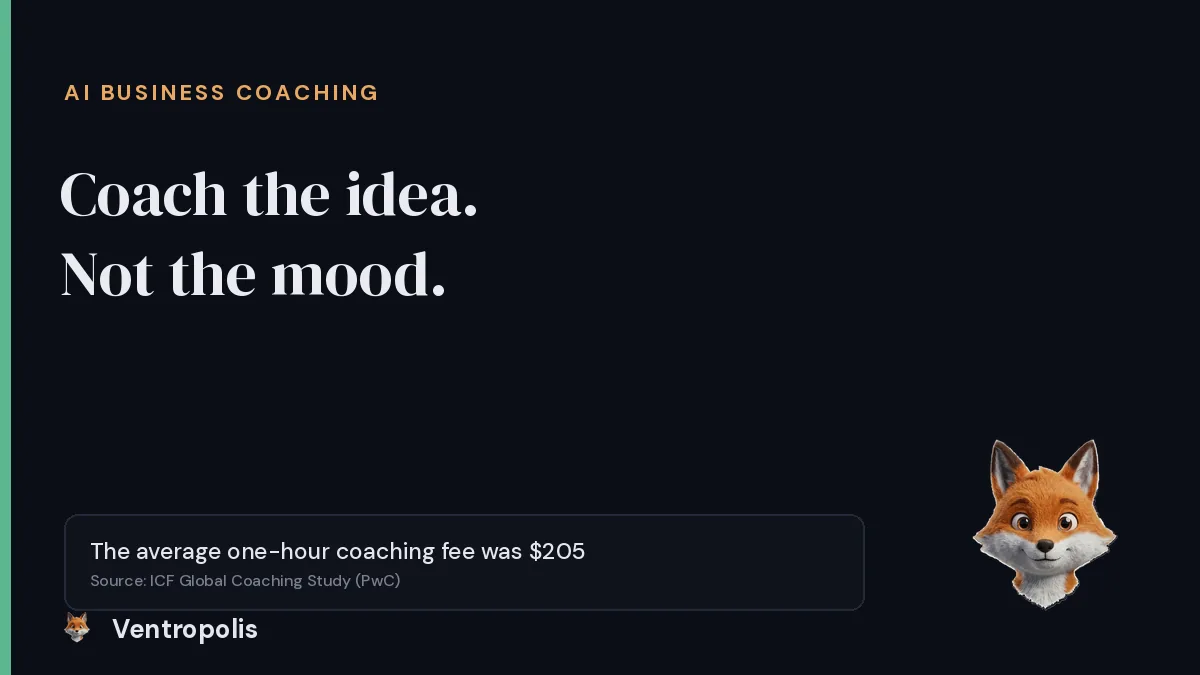
A good human business coach is expensive and hard to book. The International Coaching Federation's global study of the profession, conducted by PricewaterhouseCoopers, found the average one-hour coaching fee was $205, rising to $250 for full-time coaches. The same study found the three most common coaching specialties were all business-focused: leadership at 58.1%, executive at 57.8%, and business or organisations at 53.6%. So there is no shortage of business coaches. There is a shortage of ones an early founder can actually afford every week.
Validation does not happen on a monthly cadence. Doubt shows up on a Tuesday night when you are about to email ten prospects and your own script is quietly pitching them. That is when you need the objective voice, not three weeks later.
An AI coach is there on the Tuesday. That availability, not the price alone, is the real win.
Where the AI coach honestly stops
Now the part the marketing skips.
An AI business coach cannot hold you accountable. It will not know you skipped the ten customer calls unless you tell it. Accountability you can switch off is not accountability. A person who notices your avoidance, and who you do not want to let down, is a different force entirely.
So if you are solo and telling yourself an AI coach means you never need a human in the loop, be careful. It closes the objectivity gap brilliantly. It does not close the accountability gap. Know which one is actually hurting you, and do not let a smart tool talk you out of the discipline it is meant to support.
Where Foxy fits
This is the tool we are building, and the reason I lean on one. Foxy is built to coach the idea, not the mood: it disagrees with you on purpose, ranks your assumptions, writes your customer questions, and reads your evidence without flattery. It is the objective coach you cannot be for your own idea, not a cheerleader and not a co-founder. If that is the gap you actually have, start here.
So before you go looking for a coach, human or software, ask the harder question: do you want someone to make you feel better about your idea, or someone to help you find out if it is true?