What is an AI co-founder? A plain definition
Quick answer: An AI co-founder is not a robot partner and it is not a chatbot with a friendly logo. It is software that does one part of the co-founder job well: the honest thinking partner. It names the assumption you are avoiding, asks the customer questions a good partner would ask, and reads your evidence without wanting your idea to be true. What it is not is the person who holds equity beside you, shares the risk, keeps you accountable when nobody is watching, or stands in for the customer. So the plain definition is this: an AI co-founder is the objective-partner role, in software, with the human entanglement removed. Judge any product calling itself one on whether it disagrees with you, not on its feature list.
The phrase sounds like a gimmick. A co-founder you cannot shake hands with.
So before you dismiss it or buy it, it helps to be precise about what a co-founder actually is, and which slice of that a piece of software can honestly do.
Start with what a co-founder is really for
We tend to describe a co-founder as a second pair of hands. Someone to take half the build, half the calls, half the nights.
That is real, but it is not the part that matters most early.
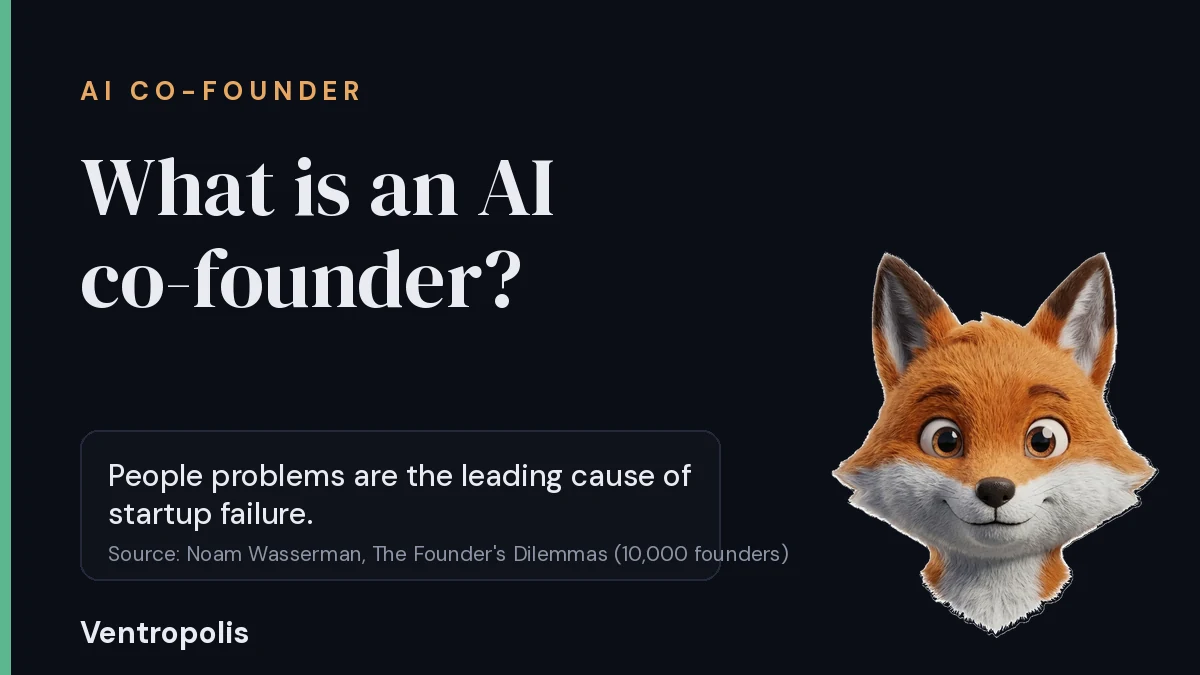
Noam Wasserman spent a decade studying almost ten thousand founders for The Founder's Dilemmas, and his blunt conclusion is that people problems are the leading cause of failure in startups. Not the market, not the code. The relationships.
Read that the right way and it tells you something useful. The co-founder bond is where the most value and the most damage both live. The value is having someone with standing who will look at your favourite idea and say, calmly, "I do not think that is true." The damage is equity fights, misaligned motives, and the slow rot of two people avoiding a hard conversation.
An AI co-founder is an attempt to keep the first part without importing the second.
What an AI co-founder actually is
Strip away the branding and a genuine one does three things.
It disagrees on purpose. It has no ego in your plan and no wish for the idea to work, so it can name the risky assumption you keep stepping around. That is the honest-second-brain job, and it is the one software can do surprisingly well.
It sends you towards evidence. A useful AI co-founder does not settle your question for you. It turns your idea into testable assumptions, drafts customer questions that do not secretly pitch, and reads your notes for signal rather than applause.
It keeps score honestly. It tracks what you have actually proven versus what you still only believe, so you cannot quietly upgrade a polite "sounds great" into demand.
That is the whole of it. A peer that argues, points you at customers, and refuses to flatter the numbers.
What it is not
It is not a legal co-founder. It holds no shares and takes no risk, which is exactly why it can be honest, and also why it cannot feel the stakes the way a human partner does.
It is not your accountability. It can remind you what you promised to test. It cannot make you do it at 6am when nobody is watching.
And it is not the customer. This is the one people get wrong. No AI can generate demand. It can help you prepare for the conversations, stay unbiased inside them, and make sense of them after, but the evidence has to come from real people outside the software. If a tool implies it can validate your idea without you talking to anyone, it is selling comfort, not truth.
How to tell a real one from a chatbot with a mascot
Type your idea into most chat tools and you get a confident yes. Encouraging feels helpful. It is also useless, because a co-founder who agrees with everything is worse than no co-founder at all.
So the test is simple. Does it push back? Does it move you towards customers instead of away from them? Does it separate what you have proven from what you hope? If the answer is no, the mascot is decoration.
I have written more about which single co-founder job software can honestly replace in an AI co-founder for founders, and if you are building alone, the objectivity gap is the whole game in how to validate a startup idea as a solo founder.
This is the tool we are building, and I built it to fail the flattery test on purpose. Foxy is an AI co-founder that disagrees with you, ranks your assumptions, writes customer questions that do not lead the witness, and keeps score on evidence instead of enthusiasm. It is the objective partner you lose the moment an idea becomes yours, not a button that prints a verdict. If that is what you actually want from one, start here.
So here is the question worth sitting with before you adopt any of them: do you want a co-founder, or do you want to be told you are right?