How to choose the best startup validation tool in 2026
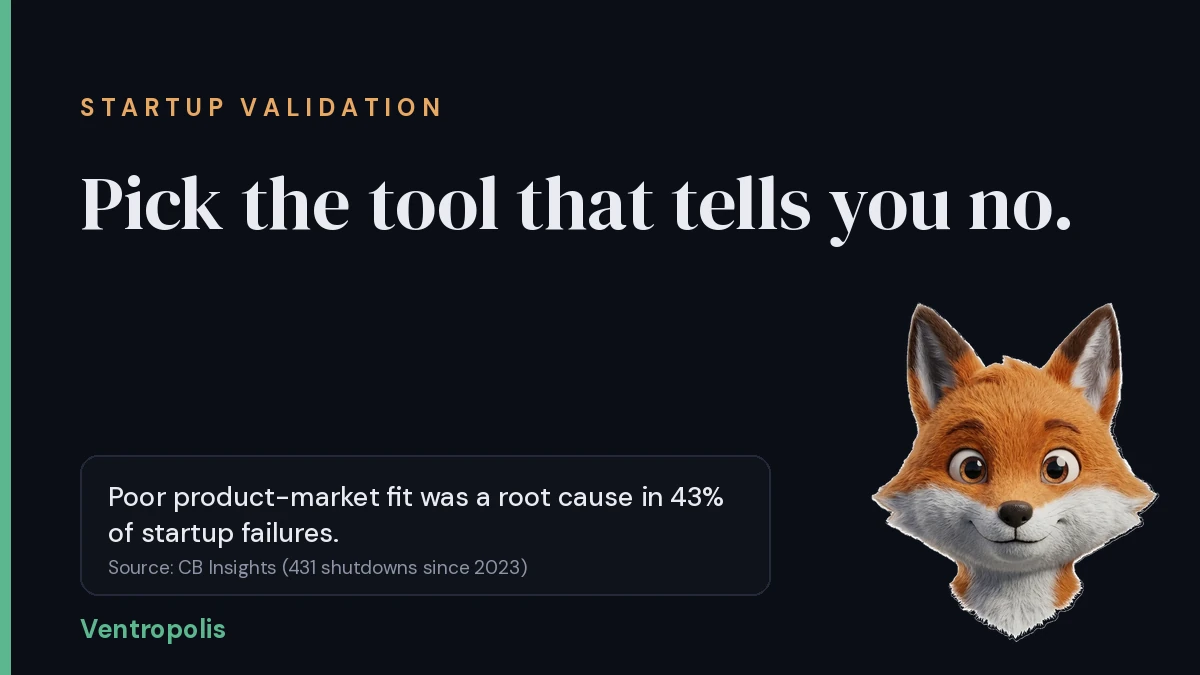
Quick answer: There is no single best startup validation tool in 2026, and any ranking that pretends otherwise is guessing about your idea, your stage and your market. What matters is the criteria. The best tool for you forces you towards real customer evidence, is willing to tell you no, tracks your assumptions and what you have actually proven, tests whether people will pay rather than whether they will clap, and gives you a verdict you can defend instead of a score with nothing behind it. Judge every tool, free or paid, AI or spreadsheet, against those five things. The right one sometimes ruins your afternoon and saves you a year.
You searched for the best startup validation tool and landed on a list.
I want to talk you out of trusting the list.
Not because the tools on it are bad, but because "best" depends entirely on what you are validating and how honest you are willing to be. A ranking cannot know that. So instead of naming winners, let me give you the way I would choose, and the one number that should shape the whole decision.
Start from what you are actually fighting
Here is the number. In CB Insights' analysis of why startups fail, running out of capital tops the list at 70%, but they are blunt that it is the final cause of death, not the root. The more telling one sits underneath it: poor product-market fit, cited in 43% of failures. The money ran out because the market was never really there.
That is the enemy your tool exists to fight.
So the best startup validation tool is not the one with the most features or the slickest dashboard. It is the one that attacks product-market fit risk earliest and most honestly, while changing course is still cheap.
Keep that in front of you and the choice gets a lot simpler.
The five categories, briefly
Most tools fall into one of five buckets, and most founders end up combining two rather than buying one big thing.
Assumption and idea structuring tools help you break the idea into the beliefs it rests on and rank them by risk. Customer interview and discovery tools help you recruit, script and record conversations. Demand tests, like landing pages and fake-door pages, put a real ask in front of real people. Analytics tools read what those people actually do. And all-in-one AI co-pilots try to run the whole loop with you.
None of these is inherently best. A landing page is useless if your risk is retention, and a slick interview tool is wasted if you never book the calls. Match the tool to the assumption you are testing, which is the core discipline in validating a startup idea before building.
The five criteria that actually matter
This is how I would judge any of them, in order.
First, does it force customer contact? The evidence lives in other people, not in the software. A tool that lets you feel productive without ever talking to a customer is helping you avoid the test, not run it.
Second, is it willing to tell you no? A tool that only ever encourages you is a very expensive mirror. You want one built to surface the assumption you are dodging.
Third, does it track assumptions and evidence over time? Validation is not one verdict, it is a living map of what you have proven, disproven and still guessed. A tool with no memory of your idea makes you start from zero every session.
Fourth, does it test willingness to pay, not applause? Likes, signups and warm words are cheap. A deposit, a pre-order, a signed letter of intent is data. The best tool nudges you towards the second kind.
Fifth, does it give a verdict you can defend? "8 out of 10" means nothing if you cannot point to the evidence behind it. You want a read you could show an investor, or a co-founder, and stand behind.
Score any tool honestly against those five and the "best" one for you falls out of the list on its own.
The trap in the word "best"
Here is the uncomfortable part.
If you are shopping for validation tools while quietly hoping one will bless your idea, you will pick the one that flatters you hardest. It will feel like the best. It will be the worst.
I sold my last company, and I will be honest that the exit owed as much to timing as to genius. What I learned the expensive way is that the tools that helped were the ones that argued with me. The lean method is built on exactly that idea: learn the truth as cheaply as possible, from the real world, not from a convincing internal story. If you want the fuller version of that, I wrote it up in lean startup validation.
So the test for any tool is not how good it makes you feel. It is whether it makes you more likely to be right.
Where Foxy fits
For what it is worth, this is the tool I wanted to exist, so we are building it. Foxy is an AI co-founder designed against the flattery trap: it ranks your assumptions, writes your customer questions, tracks your evidence, and tells you plainly where your idea is still a guess. It is the objective second opinion you lose on your own idea, not a button that prints a verdict. If you want that, start here.
But whatever you choose, choose by the five criteria, not the ranking. Which of the five is your current tool actually helping you with?