Tools to Help Portfolio Companies Validate Ideas
Quick answer: The most useful tool you can give a portfolio company is not another dashboard or a bigger cheque. It is a shared way to validate demand before they build, plus an evidence trail you can both read. Most startups do not die because the team could not build the thing. They die because nobody made them prove people wanted it first. So the tools worth handing your founders do three jobs: they force the riskiest assumption into the open, they push the team to talk to real customers, and they keep a record of what was actually proven. Capital, introductions and a shared Slack channel are useful. Evidence is what moves the odds.
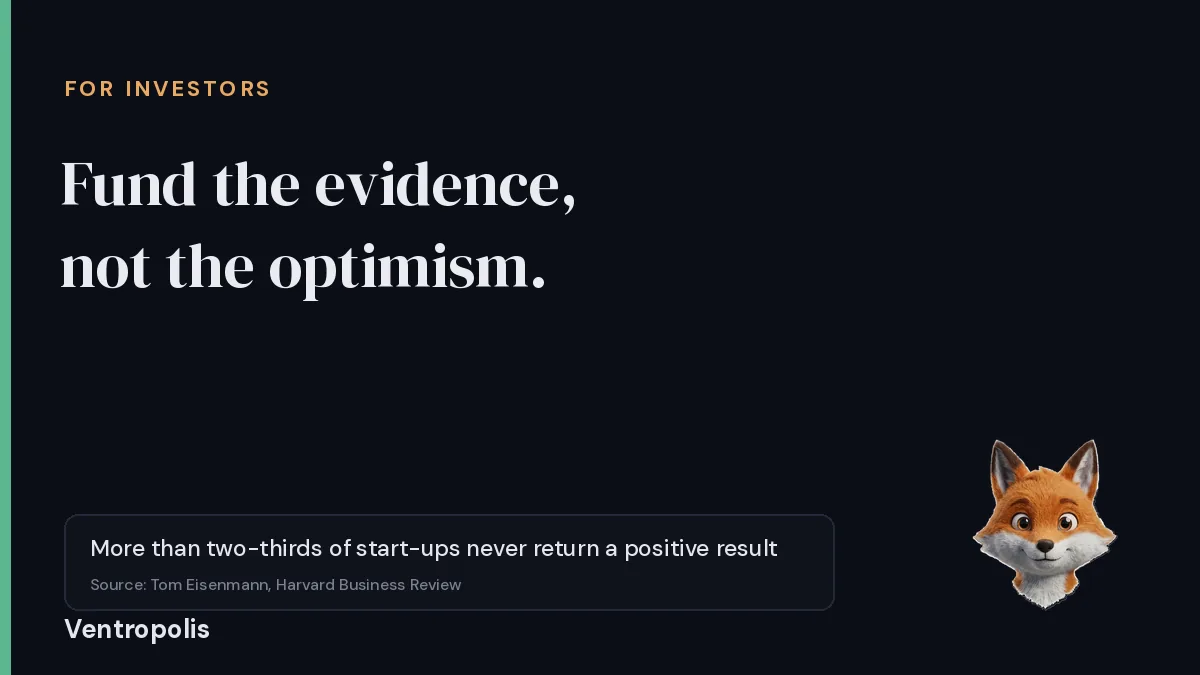
Here is the uncomfortable number. More than two thirds of start-ups never deliver a positive return to investors, and when a Harvard Business School professor set out to find out why, the cause was rarely a bad team or a bad idea on paper. One of the two most common patterns he found he calls the "false start": teams overlook a crucial step in the lean start-up process, researching customer needs before testing products, and keep rushing to launch fully functional offerings that fit no market need.Read the piece.
Read that again as an investor. The money is not usually lost to execution. It is lost to building the wrong thing quickly and well.
What "validate" actually means here
Validation is not a good meeting. It is not a founder telling you the calls went great.
Validation is a real customer doing something that costs them: paying, pre-ordering, signing a letter of intent, giving up time, switching away from what they use today. Applause is free. Commitment is data.
So when you ask what tools help portfolio companies validate ideas, the honest answer is: tools that manufacture commitment, capture it, and stop the team from lying to themselves. Everything else is decoration.
The four things a real validation toolkit does
You do not need a big stack. You need coverage of four jobs.
- Name the riskiest assumption. Every idea rests on one belief that, if wrong, sinks the rest. A good tool forces the team to write it down in plain language before anything gets built. If they cannot name it, that is the finding.
- Get the team in front of customers. Templates for interviews and outreach that ask about the person's real past behaviour, not their opinion of the idea. The questions should be impossible to answer with flattery.
- Track evidence over time. A living record of what was assumed, what was tested, and what came back. Not a slide that gets rewritten to match the current story. Founders lose objectivity on their own idea; the record should not.
- Force a decision. A gate that says continue, pivot, or stop, based on what the evidence shows. The point of validation is to make killing a weak idea cheap and fast, so runway goes to the strong ones.
That is it. That is the whole toolkit. A method, a way to talk to customers, an evidence trail, and a decision point.
What to steer them away from
Most "idea" tools measure the wrong thing. They measure enthusiasm.
Vanity dashboards that count signups nobody paid for. Survey tools that ask "would you use this" and collect a wall of polite yeses. Generic AI chat that will happily tell a founder their idea is brilliant, because agreeing is what it was trained to do. All of these feel like progress. None of them are commitment.
I have built and sold a company, so I have been the portfolio founder on the receiving end of the advice, not the one giving it. The tools that helped me were the ones that argued back. The ones that flattered me cost me time I only noticed later.
Standardise it across the portfolio
The quiet win for an investor is not helping one company validate. It is giving every company the same language for evidence.
When each founder reports in the same shape, riskiest assumption, the test, the result, you stop comparing pitches and start comparing progress. You can see which company is learning and which is just busy. That is the difference between a portfolio review that is theatre and one that tells you where your next hour should go.
If you want the founder-side version of this, I wrote about how to validate a startup idea before building, and if you are assessing a company from the outside, the angel investor due diligence checklist covers what to look for.
Where Foxy fits
This is the tool we are building, so I will be direct about what it is for. Foxy is designed to do the four jobs above for a founder: it makes them commit the riskiest assumption in writing, it writes customer questions that do not secretly pitch, it keeps the evidence so nobody can quietly rewrite history, and it tells them plainly where the idea is still a guess. For an investor, it means your portfolio speaks one honest language about evidence instead of ten different pitch decks. It is a scorekeeper for an idea, not a cheerleader. If that is the tool you want in your founders' hands, start here.
So before you send the next wire or make the next introduction, ask the simpler question: what has this team actually proven that a customer paid for, and how would you know if they were fooling themselves?