The angel investor due diligence checklist that pays for itself
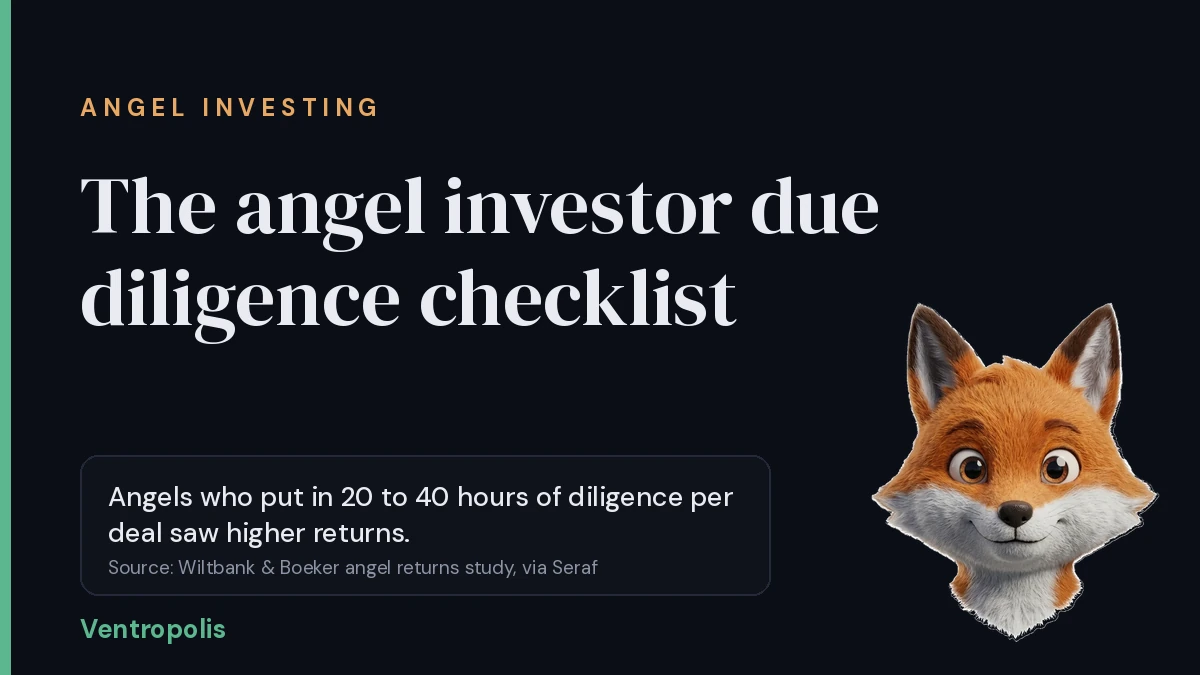
Quick answer: Angel investor due diligence is the work you do before you wire money to prove the story is true: that the problem is real, that customers already pull for the solution, that the founder can execute, and that the terms are fair. It matters more than most angels admit. In the largest and most widely cited study of angel returns, the investors who put in more hours of diligence per deal, roughly 20 to 40, saw better returns than those who put in less. Below is a checklist you can actually run, ordered by what kills deals fastest: demand first, then founder, then model, then terms.
Most bad angel cheques are not unlucky. They are underexamined.
You liked the founder, the deck was clean, the room was warm, and you skipped the boring part. That is the expensive part.
Diligence is the closest thing to an edge you have
Here is the finding that should change how you spend your evenings. The largest and most widely cited study of angel returns, by Robert Wiltbank and Warren Boeker, looked at thousands of investments and found the average return was about 2.6 times the money in roughly three and a half years. Buried in the same study is the more useful bit: angels who put in more due diligence time, in the range of 20 to 40 hours per deal, tended to see better returns than those who did less.
Read that again. The lever was not access to hotter deals or a better nose. It was hours.
That is good news, because hours are the one input you fully control.
Run the checklist in order of what kills deals
Do not start with the cap table. Start with the thing most likely to be fatal, and stop early if it fails. The order below is deliberate.
1. Demand: is the problem real and painful?
This is the gate. If it fails, nothing downstream matters. Most startups that die do not lose to a rival or a hard build. They build something not enough people needed, the pattern behind why startups fail.
Check for:
- Evidence the founder has talked to real customers, not friends. Ask to see the notes.
- A problem stated in the customer's words, with a frequency and a cost attached.
- Signs the customer already spends money or time on a workaround. A painful problem always has a current cost.
- A clear answer to "who is this not for?" A founder who says "everyone" has not found the wedge yet.
2. Willingness to pay: has anyone actually committed?
Interest is free. Commitment is data.
Look for pre-orders, a signed letter of intent, a paid pilot, a deposit, a waitlist that converted, anything where a customer gave up something real. Applause and sign-ups are the easiest signals to fake and the least predictive. If the only proof of demand is enthusiasm, treat the demand as unproven.
3. Founder: can they execute and can they update?
You are betting on a person for a long time. Two traits matter more than charisma.
Can they execute in this specific domain, with evidence they have shipped or sold something before? And more importantly, do they update when the data disagrees with them? Push on a weak point and watch. A founder who gets defensive under a hard question will get defensive with the market, and the market does not care about their feelings.
4. Market and model: does the math survive contact?
Now the numbers. Sanity-check the market size from the bottom up, not the "1 percent of a huge number" slide. Look at unit economics: what it costs to get a customer, what that customer is worth, and whether those two numbers point the right way. Understand how the business actually makes money, and where it breaks if a key assumption is wrong.
5. Deal and hygiene: is it clean and fair?
Last, the boring guardrails. A clean cap table with no dead equity. Clear ownership of the IP. No unresolved legal or founder-dispute landmines. Terms and a valuation that leave room for the next round without crushing everyone. This is where a lawyer earns their fee.
If a deal fails at gate one, you saved yourself the other four steps. That is the point of the order.
The founder side of the same coin
Everything above has a mirror image on the founder's desk. The evidence you are hunting for as an investor is exactly the evidence a good founder should be assembling before they ever pitch you, which is the whole idea behind showing investors your idea is validated. When a founder walks in with the demand already proven, your diligence gets faster and your conviction gets higher. When they walk in with a story, you do the work they skipped, or you pass.
Where Foxy fits
The hardest part of diligence is staying honest when you want the deal to be good. You have already pictured the win. That is the same blind spot founders have about their own ideas, just pointed at a company instead of a product. We are building Foxy, an AI co-founder, to be the objective second read on exactly that: it works through the customer evidence and flags where the proof is thin and which assumption everyone in the room is quietly avoiding. If you back founders and want them arriving with real evidence instead of a warm story, start here.
So before your next cheque, one question. If this company is going to fail, which of the five gates would have told you, and did you actually spend the hours to check it?