How to show investors your idea is validated
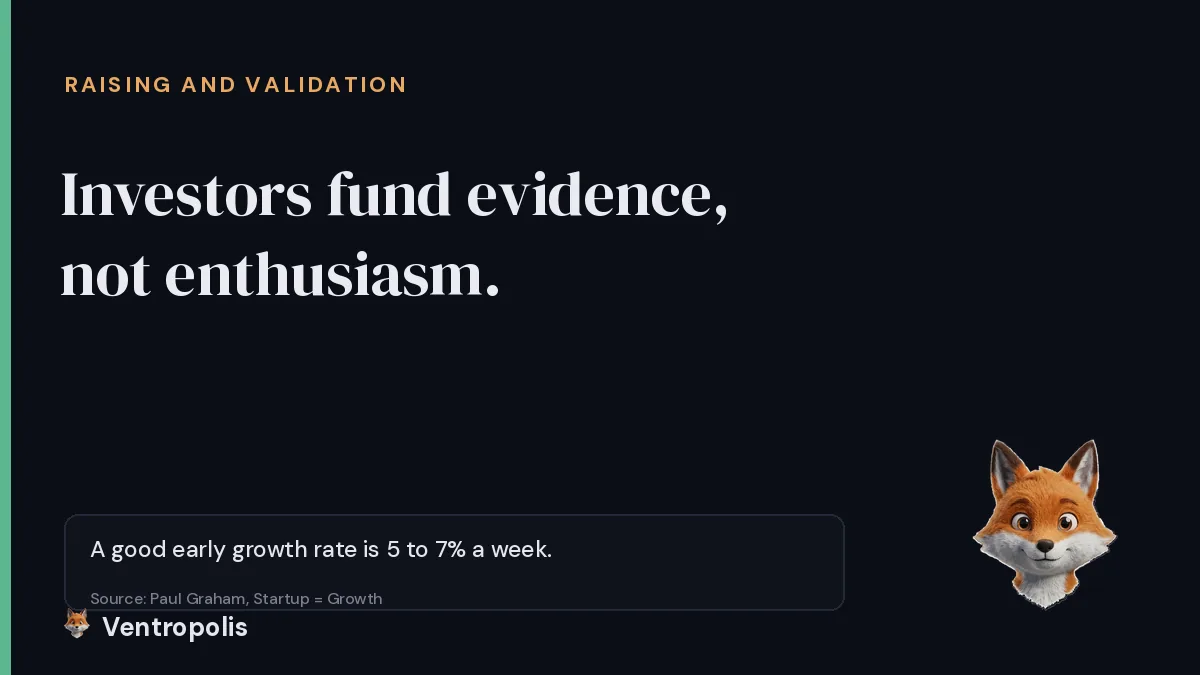
Quick answer: Investors do not fund your idea, and they do not fund your confidence. They fund evidence that people want the thing and that the wanting is growing. So "validated" is not a feeling, it is a small pile of facts you can show: real demand from specific people, willingness to pay (pre-orders, letters of intent, paying pilots), and a growth rate that is going up. The single most persuasive number is the rate of change. As Paul Graham puts it, growth is "the measure of a startup", and if you cannot show a rate, you are showing a story. If you have none of this yet, do not fake it. Show the cheapest honest evidence you have and be clear about what you are still testing.
"Validated" is evidence, not enthusiasm
Picture the pitch. You have the deck, the vision, the big market slide. You believe.
Then someone across the table asks the quiet question: "What have you actually seen?"
That question is the whole game, and most founders answer it with adjectives. Huge market. Massive pain. Incredible feedback. None of it is evidence. It is enthusiasm wearing a suit.
An investor is not trying to be cruel. They are trying to tell your belief apart from reality, because you cannot. You want the idea to be true, so every warm reply looks like proof. I have done this myself. The fix is to walk in with facts that would survive you being wrong.
Applause is free. Evidence costs someone something.
The three things investors actually read
Strip away the story and there are three proofs that matter.
One: demand from specific people. Not "the market is 40 billion". Specific humans with the problem who did something about it. Ten discovery calls where the same pain came up unprompted. A waitlist that came from a real channel, not your friends. The point is that the interest is theirs, not a reaction to your pitch. Enthusiasm from people who will never buy is the trap I unpack in why people say they love your idea but won't pay.
Two: willingness to pay. This is the one that separates a hobby from a business. A pre-order, a signed letter of intent, a paid pilot, a deposit. Something that cost the person money or reputation. If you have not tested it yet, that is the first thing to fix, and I wrote a whole piece on how to test willingness to pay.
Three: a growth rate. Not a total. A rate. "We got a hundred new users" is not a rate, it is a number that could mean you are slowing down. What investors read is the slope: how much bigger this week is than last week.
Why the rate of change beats every other number
Paul Graham's essay Startup = Growth makes the case as bluntly as anyone: "A startup is a company designed to grow fast", and the only essential thing is growth. He goes further. "If there's one number every founder should always know, it's the company's growth rate. That's the measure of a startup."
He even gives the benchmark. During Y Combinator, a good growth rate is 5 to 7 percent a week. Hit 10 percent and you are doing exceptionally well. Manage only 1 percent, and it is "a sign you haven't yet figured out what you're doing".
You do not have to be raising from YC for the logic to hold. A rate tells an investor whether the thing is catching. A total tells them nothing, because a big total can be flat. Graham's advice is to measure the growth of revenue where you can, and active users as a proxy where you cannot yet charge.
So the slide that lands is not "500 users". It is "growing 9 percent week on week for the last six weeks, here is the chart".
If you do not have the evidence yet
Most founders reading this do not have a growth chart. That is fine. The mistake is not a lack of traction. The mistake is dressing up a lack of traction as traction.
Do the opposite. Show the smallest real evidence you have and name exactly what you are still testing. Ten honest customer interviews with concrete facts about how people solve the problem today beat a fabricated hockey stick every time. A landing page with fifty real signups from a cold channel beats a claim of "strong interest". Three paying pilots beat a thousand hand-raises.
I have been through a full startup cycle before, sale at the end, and the thing I underrated for too long was how much a small piece of true evidence outweighs a big confident story. Investors have seen the confident story a thousand times. They have seen far fewer founders who can say "here is what we tested, here is what happened, here is what we do not know yet".
That honesty is itself a signal. It says you run on evidence, which is exactly the founder they want to back.
Where a second opinion helps
The hard part is that you are the worst judge of whether your evidence is real. You will count a polite yes as demand and a flat number as growth, because you want to.
This is where an objective second read earns its place. Ventropolis, powered by Foxy, is built to be the check you cannot be for yourself: it presses you to separate a compliment from a commitment, and a total from a rate, before you put it on a slide. Not a magic button, just the cold question an investor would ask, asked earlier. You can pressure-test your evidence at Ventropolis for startups.
Build the three proofs. Demand, willingness to pay, a rate. Then show the smallest true version of each.
So before your next pitch, ask yourself the quiet question first: what have you actually seen, and would it survive you being wrong?
Sources
- The case that growth is the essential measure of a startup, with the 5 to 7 percent weekly benchmark and the revenue-or-active-users rule: Paul Graham, Startup = Growth.