Startup validation is overwhelming: where to actually start
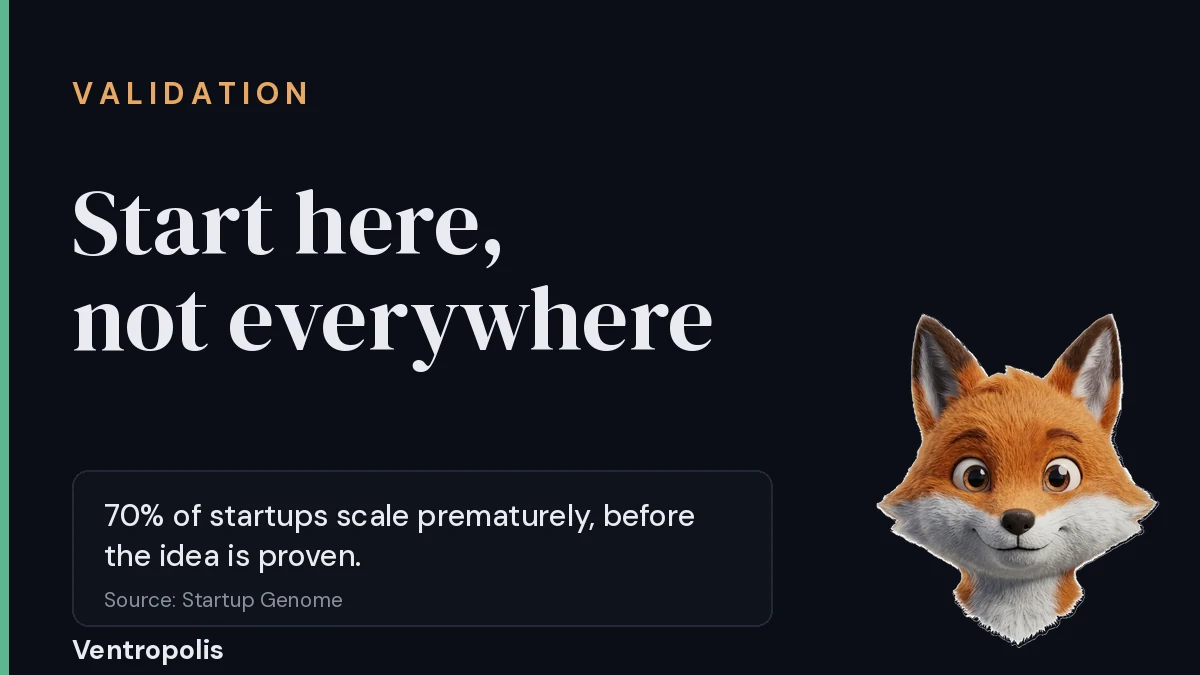
Quick answer: When validation feels overwhelming, stop trying to test everything at once. Start with one thing: the single assumption that, if it is wrong, kills the whole idea. For most startups that is "enough people have this problem badly enough to pay to solve it." Test that first, with cheap conversations and a small demand signal, before you build, hire, or spend on ads. Startup Genome's research found that scaling any part of a business before the idea is proven is the most common way startups die. So the starting line is not doing more. It is refusing to scale until the riskiest assumption holds.
You open a blank doc to "validate the idea" and freeze.
Interviews, surveys, a landing page, pricing, competitors, a waitlist, an MVP. It all needs doing, apparently, and all at once. So you do the easy visible thing, which is usually starting to build.
That instinct is the trap.
The starting line is one assumption, not a hundred
Validation is not a giant to-do list. It is a search for the one thing that would end your idea if it were false.
Every idea rests on a few things that must all be true. People have this problem. They have it often enough to care. They will pay to solve it. You can reach them. Write those down, then ask a blunt question: which one, if it turned out false, kills the business?
That one is your riskiest assumption. It is where you start. Everything else waits.
For most early ideas the answer is the same: not enough people want this badly enough to pay. So that is what you test first, and you test it before you have built the thing you are hoping they will buy.
Why "start by building" is the expensive mistake
There is a strong pull to start by making something. It feels like progress you can see.
The data says it is the opposite. Startup Genome analysed over 3,200 high-growth startups and found that the primary cause of failure was premature scaling, which 70% of startups in their dataset showed. Premature scaling means pushing one part of the business ahead of the evidence: building product, hiring a team, or spending on acquisition before the idea is actually proven.
Their model is useful here. They describe startups moving through stages, Discovery, then Validation, then Efficiency, then Scale, in that order. The startups that die tend to behave like they are three stages further along than they really are. They scale the response before they have proven the need.
So "where do I start" has a clear answer. You start by not scaling anything. You sit in the validation stage and earn the right to leave it.
The cheapest test that could prove you wrong
Once you know the assumption, the test is usually small.
Talk to ten people who have the problem. Do not pitch. Ask what they do about it today and what it costs them. Then put a real demand signal in front of them: a landing page, a mockup, a pre-order, something that asks for a small commitment rather than a compliment. A yes with a card, a deposit, or a booked call is worth a hundred "sounds great."
This is a loop you can run in a fortnight, and it is laid out step by step in a startup idea validation framework. If you want the wider view of what it means to validate before you build, how to validate a startup idea covers the whole loop.
The point of starting small is not thrift. It is that a cheap test can afford to fail, and a failed test in week two is a gift.
Where Foxy fits
The reason validation feels overwhelming is that you are holding the whole idea in your head and every part feels equally urgent. That is exactly what an outside view is for. We are building Foxy to be that: an AI co-founder that helps you name your riskiest assumption, then reads your customer conversations and tells you whether the evidence is actually there or whether you talked yourself into it. If you want help finding your starting line, start here.
So here is the only question that matters this week. What is the one thing that, if it is false, means none of the rest is worth building?