What is innovation in business?
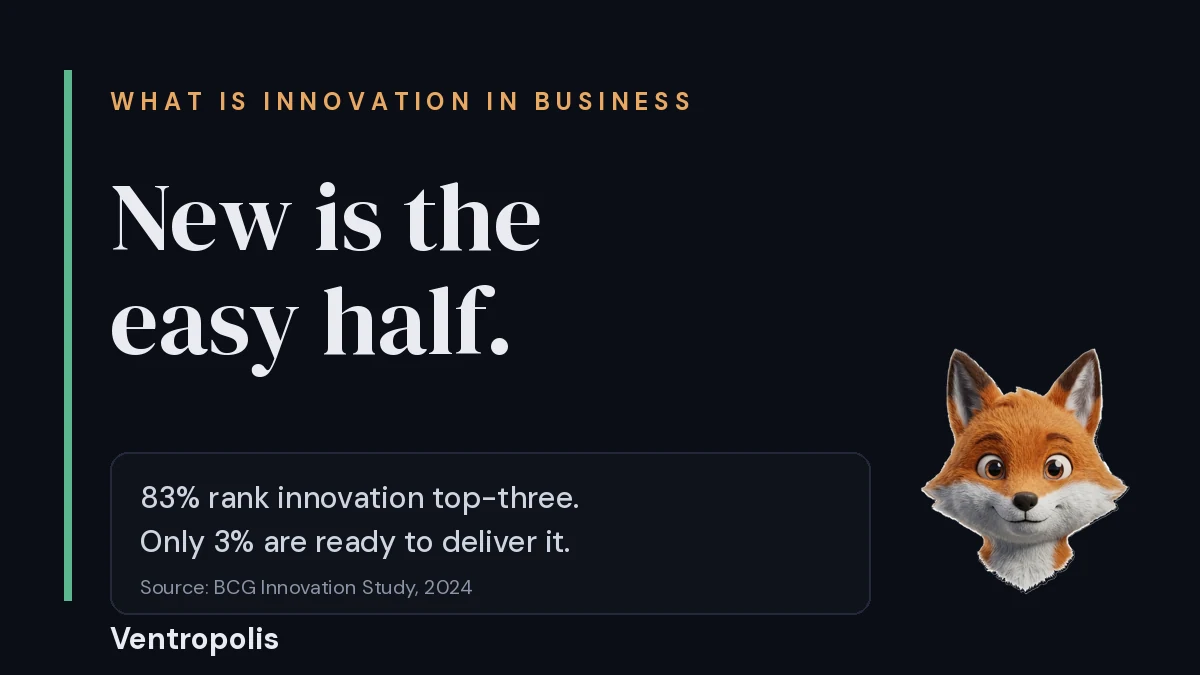
Quick answer: Innovation in business is a new idea, method, product or model that customers actually adopt and pay for. Novelty is not the test. Adoption is. Invention creates something new; innovation is what happens when the market picks it up and hands over money or time to keep it. Most things called innovation never clear that bar, which is why they quietly disappear.
Most "innovation" in business is just change with a nicer word attached.
A redesign. A rebrand. A feature nobody asked for, shipped so the roadmap slide has something on it. All of it gets called innovation, and almost none of it is.
So let me give you the definition I actually use, and then why the distinction is worth caring about.
The working definition
Innovation in business is a new idea that customers adopt and pay for.
Three parts, and each one earns its place.
New: it has to be different from what came before, in the product, the model, the process or the route to market. A cheaper way to distribute counts. A smarter price counts. It does not have to be a gadget.
Adopted: people change their behaviour to use it. This is the part everyone skips. An idea sitting in a deck is not innovation. An idea people are using is.
Paid for: they give up something they value to keep it, money, time, or switching cost. That is the difference between a thing people admire and a thing people need.
Miss the last two and you have an invention, or a hobby, or a very expensive opinion. Not an innovation.
Invention is not innovation
This is the trap I see most. Founders equate "new" with "innovative" and stop there.
New is the easy half. Getting a real customer to reorganise their day around your new thing is the hard half, and it is the only half the market scores.
You can invent constantly and never innovate once, because innovation is measured by uptake, not by cleverness. The graveyard of startups is full of genuinely novel products that nobody adopted.
I wrote a broader piece on what innovation is if you want the general version. This one is specifically about business, where the scoreboard is customers and revenue, not applause at a conference.
Why the gap is so wide
Here is a number that should worry every leadership team that has "innovation" on a slide. Boston Consulting Group's annual study found that 83 percent of companies rank innovation as a top-three priority, yet only 3 percent were ready to deliver on it, down from 20 percent two years earlier. The most common reason cited was an unclear or overly broad strategy.
Read that again. Everyone wants it. Almost nobody is set up to get it.
The gap is not a shortage of ideas. It is a shortage of proof. Companies fund activity (more projects, more demos, more AI pilots) and call it innovation, without ever checking whether a customer will adopt and pay.
I have taken a company all the way to an acquisition once. It worked out, with more luck in the early calls than I like to admit. The thing I got wrong for too long was exactly this: I counted ideas and activity, when I should have been counting adoption. Novelty felt like progress. It was not.
How to actually innovate (the boring answer)
Start from a problem a customer already feels, not a technology you already like. Then test whether they will commit to your version before you build the whole thing.
That is it. Find the real problem, get real commitment, then scale. Adoption evidence first. Everything else is decoration.
If you want the mechanics of doing this deliberately rather than on instinct, I put more of it in AI-driven innovation.
This is also the whole reason we built Ventropolis. Foxy, our validation agent, exists to keep you honest about the part everyone skips: will a real customer adopt this and pay, or do they just like it? If you are trying to turn an idea into something the market actually takes up, start here.
So before you call your next project innovation, ask the only question that settles it: has anyone outside your building adopted it and paid, or does it just look new?