What is technological innovation, and which kind are you doing
Quick answer: Technological innovation is using technology to change what a business can do for people, in a way that actually reaches them. New tech on its own is not innovation. And it comes in types: sustaining innovation improves an existing product for your best customers, disruptive innovation makes something cheaper and more accessible for people who were priced out, and efficiency innovation makes the same product cheaper to deliver. The type you are doing decides who you sell to and how you win.
Everyone says they are disrupting.
The word gets stapled to a slightly cheaper app, a new feature, a fresh coat of paint. Most of the time that is not disruption. It is a sustaining improvement wearing a bigger word.
Knowing the difference is not pedantry. It changes who you build for.
What the phrase actually means
Technological innovation is a change that turns lower value inputs into higher value outputs, and then reaches real people. The technology is the enabler. The change in what someone can do is the innovation.
That second half is where most attempts die. You can bolt a new model onto a product that already works and call it innovation. If nobody's behaviour changes, it is a feature, not an innovation.
Behaviour changed, or not. That is the test.
The types worth knowing
The Christensen Institute sorts technological innovation into a few clear types, and the distinction is genuinely useful.
Sustaining innovation makes an existing product better for the customers who already pay the most. Every new version of a flagship phone is sustaining. It is real work, and it usually sells for more money at a higher margin.
Disruptive innovation goes the other way. It produces a simpler, more affordable option that serves people at the low end, or people who could not access the market at all.
Efficiency innovation changes the process so the same product costs less to make, freeing up cash. Same customers, cheaper delivery.
Most founders assume they are in the disruptive column. Look honestly and a lot of us are doing sustaining work: a bit better, for the same customers a big incumbent already owns. That is the hardest fight there is.
Disruption is not "better"
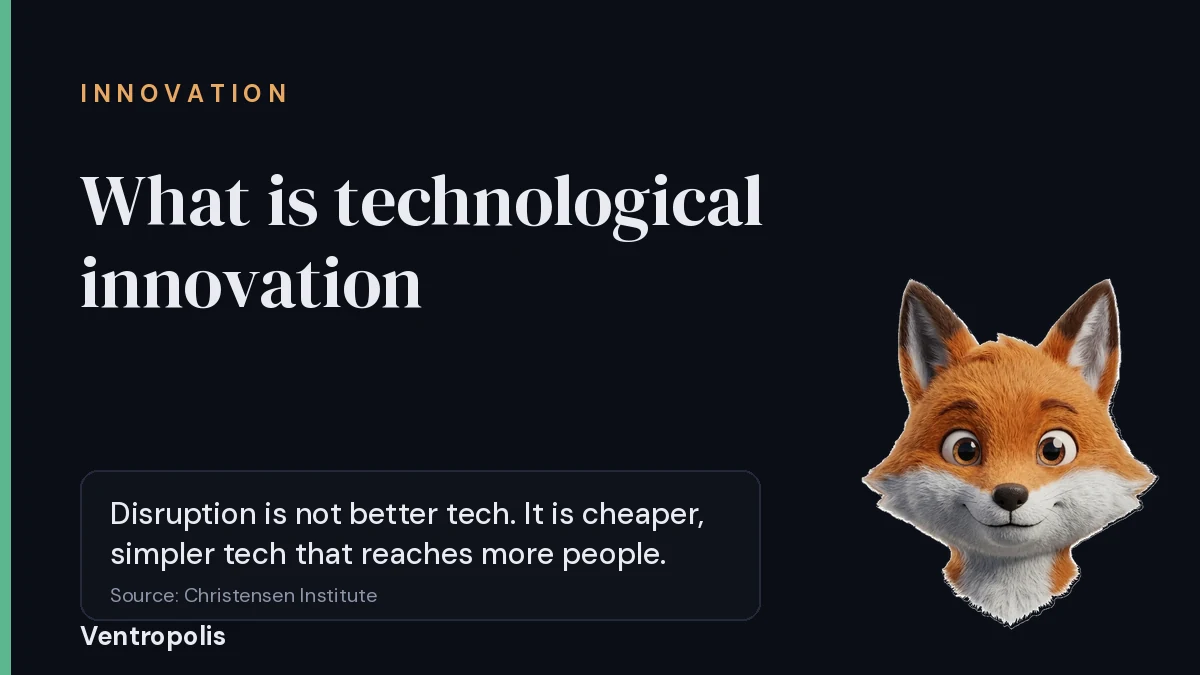
Here is the correction that matters most. The Christensen Institute is blunt about it: disruptive innovations are not breakthrough technologies that make good products better. They are innovations that make products and services more accessible and affordable, so a larger group of people can use them.
Think about how one entrant beats a much bigger one. It usually starts with something the incumbent thinks is too cheap or too basic to bother defending, aimed at customers the incumbent is happy to ignore. Then it moves up. By the time it is a threat, the incumbent has already ceded the ground.
So "our tech is more advanced" is not a disruption plan. "Our tech lets people who were priced out finally do this" might be.
If you are wondering whether your direction still fits the market you are chasing, I wrote about when to pivot rather than abandon an idea, and about what AI driven innovation really requires beyond the model itself.
Why the type decides your strategy
Pick the wrong column and you aim at the wrong people.
Sustaining means you are competing head-on with whoever already owns the best customers. You had better be clearly better and able to outspend them, or have a real edge they cannot copy.
Disruptive means you are starting where they are not looking. Cheaper, simpler, good enough for people they overlook. Weaker on paper, and much harder for the incumbent to chase without hurting their own margins.
Neither is wrong. But you cannot run one play while believing you are running the other.
This is the kind of question Foxy is built to press on at Ventropolis: an objective second read that asks who you are really for and whether the market agrees, before you commit months to the build. Not a verdict, just the questions you are too close to ask. If that helps, start here.
So which one are you actually doing: making the good thing better, or making the out-of-reach thing reachable?