The Mom Test questions that reveal real demand
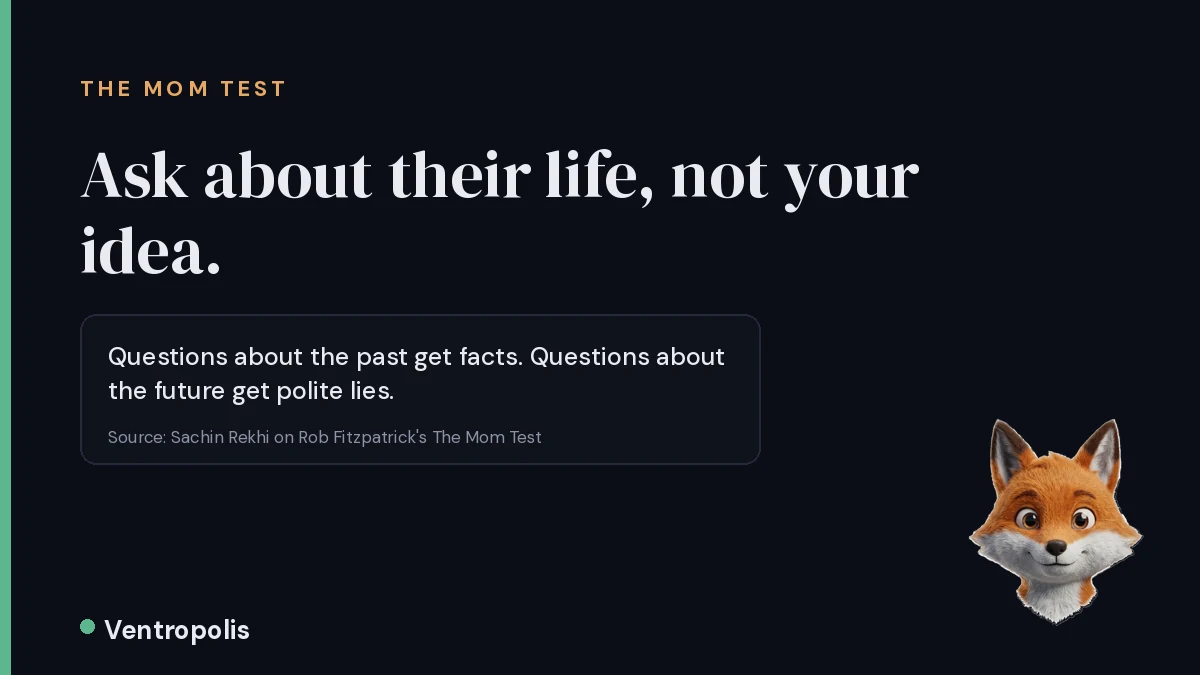
Quick answer: The Mom Test is a set of questions designed so that even someone who loves you cannot lie to you about your idea. The trick is to stop asking about your idea at all. Ask about the person's real life instead: their goals, the last time the problem actually bit them, what they use today, and what it costs them in time or money. Then ask for a commitment, not a compliment. Good questions sound like "When did this last happen and what did you do?". Bad questions sound like "Would you buy this?". The first gets you facts. The second gets you a polite lie you will mistake for a green light.
Why people lie to you (and it is partly your fault)
Ask your mother whether your business idea is good and she will say yes. She loves you. She does not want to hurt your feelings.
The problem is that almost everyone does this, not just your mother.
The moment you describe your idea and ask what someone thinks, you have contaminated the conversation. They stop reacting to their own life and start reacting to your ego. As Sachin Rekhi puts it in his primer on Rob Fitzpatrick's The Mom Test, questions like "I had an awesome idea for an app, do you like it?" will "likely garner compliments that are impossible to trust".
Compliments feel like progress. They are the most expensive thing you can collect, because they cost you nothing to hear and everything to believe.
Move one: talk about their life, not your idea
The counter-intuitive rule is to avoid pitching your idea in early conversations entirely.
Instead, dig into whether the person even has the problem. If you were building a fitness app, you would not ask "would you use a fitness app?". You would ask:
- "What are your big goals right now? Is getting healthier on that list?"
- "How often do you go to the gym? If not often, why not?"
- "When did you last try? Have you ever joined a gym or taken up running?"
Every one of those is about their world, not your product. They cannot lie to you about how often they went to the gym last month. They can lie all day about whether they would use your app.
I unpack the interview mechanics further in customer discovery interview questions that don't lead the witness.
Move two: ask about the past, not the future
The most common bad question is a hypothetical: "Would you buy a product that did X?".
You are asking an optimistic person to predict their own future behaviour while trying to make you happy. The answer is worthless.
Swap every hypothetical for a specific memory. How do they solve this today? What does that cost them, in money and in time? Walk me through the last time this came up. If they have not solved it, why not: have they searched for a fix and given up, or do they not care enough to have Googled it once?
Past behaviour does not lie. "I would definitely pay for that" is a wish. "I paid for three tools last year and cancelled two" is a fact.
This is the same reason enthusiasm is not evidence, which I get into in why people say they love your idea but won't pay.
Move three: end with a commitment, not a compliment
Eventually you do show the idea, and you will hear lovely things. "That's so cool." "I'd definitely buy that." "Let me know when it launches."
None of it counts. It is all cheap to say.
So end the conversation by asking for something that is not cheap. Rekhi groups the commitments worth asking for into three kinds:
- Time: a scheduled next meeting with a clear goal, or sitting down to review your wireframes.
- Reputation: an intro to their peers, their boss, or their spouse.
- Money: a letter of intent, a pre-order, or a deposit.
A real commitment costs them something they value. Until you have given them a concrete chance to reject you, you do not have a lead. You have a fan.
The strongest signals combine two: agreeing to pilot the tool costs both their time and their reputation inside their team.
The hard part is hearing the answer
Knowing the questions is easy. Asking them when you are desperate for a yes is not.
You will feel the pull to slip in "so, would you use it?" because a real answer might sting. That pull is the whole reason founders keep building things nobody wants.
This is where an objective second read earns its place. Ventropolis, powered by Foxy, is built to be the check you cannot be for yourself: it pushes you to ask about their life instead of your idea, and to treat a compliment as noise until a commitment turns it into signal. Not a magic button, just the cold question you would rather skip. You can bring your idea to Ventropolis for startups and pressure-test it.
Write your questions before your next conversation. Cut every one that mentions your idea. Cut every one about the future.
Then ask yourself: are you interviewing your customer, or auditioning for their applause?
Sources
- Three takeaways from Rob Fitzpatrick's book, with example questions and the commitment ladder: Sachin Rekhi, A Primer on Talking to Customers From Rob Fitzpatrick's The Mom Test.