AI innovations that actually stuck, and the ones that were just demos
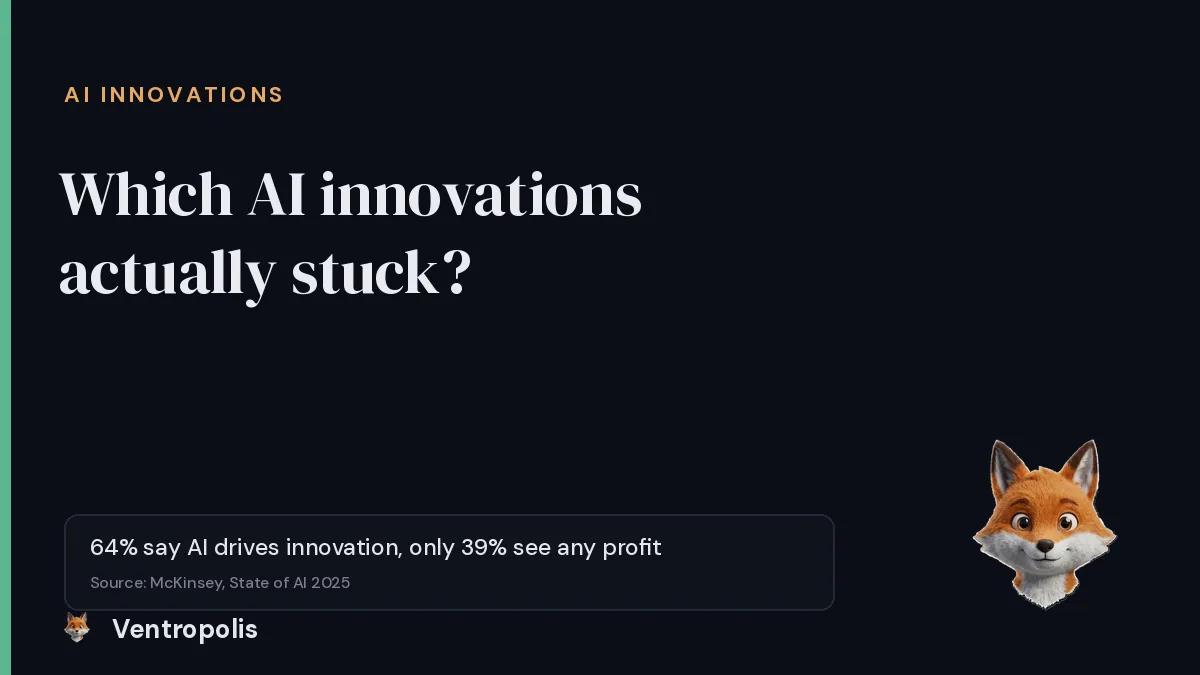
Quick answer: An "AI innovation" only counts when it is both new and actually used, and most aren't yet. In McKinsey's 2025 State of AI survey, 88% of organisations report using AI and 64% say it is enabling their innovation, but only 39% see any profit impact and nearly two-thirds haven't scaled it past pilots. The AI innovations that stuck all did the same thing: removed a real chore inside a workflow people already had. The ones that died were features nobody opened. If you're building one, the differentiator isn't the model; it's whether someone's Tuesday actually changed.
There has never been more "AI innovation" and never been a wider gap between the ones that matter and the ones that are just a good demo.
I want to give you a way to tell them apart, because it's the same test that decides whether the thing you're building will still be used a year from now.
The scoreboard nobody puts on the slide
McKinsey surveys thousands of companies on this every year. The 2025 numbers are worth sitting with: 88% of organisations now use AI in at least one function, up from 78% a year earlier. 64% say AI is improving their innovation.
And 39% report any profit impact at all, and most of those say it's under 5% of EBIT. Nearly two-thirds have not begun scaling AI across the business.
So: almost everyone is using it, most feel more innovative, and very few can show it on the bottom line. That is not a contradiction. That is the gap between the two halves of the word. Lots of novelty. Not much adoption.
What the AI innovations that stuck have in common
Look at where the value actually showed up in that survey (software engineering, IT, marketing and sales) and a pattern falls out. The AI innovations people kept using all removed a specific, recurring chore inside a workflow they already had:
- Coding assistants that draft and review code while you work.
- Support copilots that resolve tickets faster and get better with volume.
- Transcription that writes the meeting notes nobody wanted to write.
- Content tools that turn a blank marketing page into a rough first draft.
None of these asked anyone to change who they are. They slid into an existing habit and made a painful minute cheaper. That's it. That's the whole trick.
What the demos have in common
The AI innovations that died shared a different pattern. They were features looking for a habit. A chatbot bolted onto a product nobody was struggling with. An "AI-powered" dashboard that answered a question no one was asking. A pilot that impressed the room, got a budget line, and quietly never scaled.
Nothing was broken about them. The model worked. They failed the adoption half: the underlying problem just wasn't painful enough to make anyone change their behaviour, and no one checked before building.
This is the trap I care about, and it catches everyone the same way, from a two-person team to a division inside a large company. "We use AI" feels like a strategy. It isn't. It's a component. Adding AI to something nobody wanted gets you a faster route to irrelevance. I've written about why that framing misleads people in AI innovation is not the hard part, and about where AI helps versus hurts inside the building process itself in innovation and AI.
How to make your AI innovation one that sticks
The good news is the test is cheap and it takes weeks, not months.
Name the chore. Not the technology, but the specific, recurring, annoying task your AI removes from someone's day. If you can't name it in one sentence, you have a demo.
Find ten people who have that chore. Ask them about the last time it cost them something. Don't pitch. The moment you pitch, the answer turns polite and useless.
Get one real commitment. A paid pilot, a budget sign-off, a pre-order, a booked rollout. Enthusiasm is free; commitment is the signal that the problem is real.
Redesign the workflow, don't bolt on. McKinsey's clearest finding is that the high performers weren't the ones with the fanciest models; they were the ones who redesigned how work happens around the tool. Adoption is a design problem, not a model problem.
Do that, and you're building the kind of AI innovation that's still in use next year, not the kind that gets a nice screenshot and a slow death.
The part I actually care about
When it's your own idea, you are the worst judge of whether the chore is real. You hear the "cool!" and skip the shrug. That's why we built Ventropolis into a validation engine: you feed it the idea you're excited about and it pressure-tests the demand against real evidence, reading your customer conversations, checking whether anyone actually has the problem, and telling you where the signal is thin instead of what you want to hear. If you want to run your AI innovation through that before you build it, try Ventropolis.
So, honestly: which half is your AI innovation on right now, the novelty, or the used?
And what's the one chore you could confirm is real this week?